What is gofio, and why is this windmill named after it?
Before bread, before potatoes, even before the Castilians: the toasted flour that kept the Canary Islands going for centuries, the white windmills that ground it and why, in 1996, someone built a new one when hardly any were left standing.
· 4-minute read
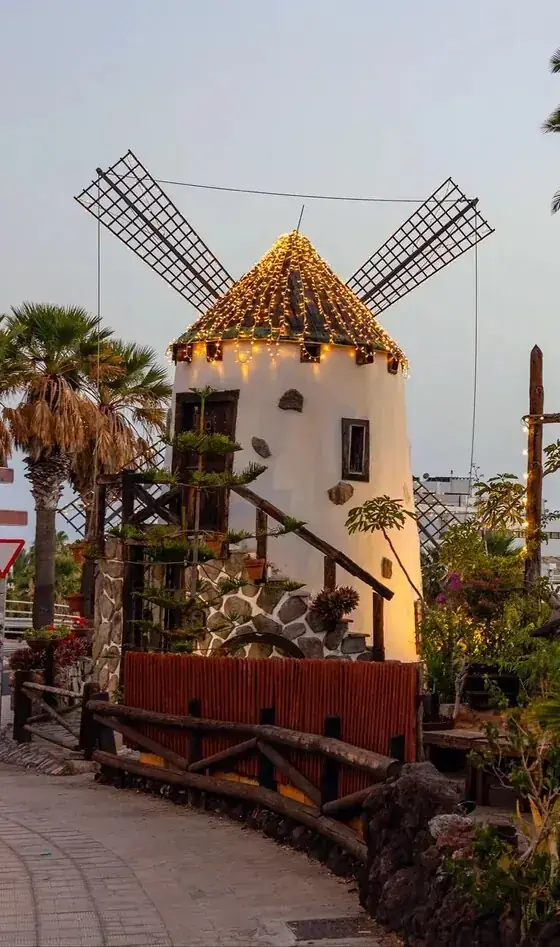
What exactly is it?
Gofio is flour made from toasted grain. That's the whole definition, and it's what sets it apart from any other flour: the grain is toasted before it's ground, not after. It can be maize (millo, as it's called here), wheat, barley or a mix. That's why it smells of fresh bread while it's still a powder, and why you can eat it without cooking it.
It isn't something made up for tourists, or a restaurant recipe. People in the Canary Islands have eaten it since before the Castilian conquest: the Guanches ground toasted grain in hand mills of volcanic stone and lived on it. When the ships arrived, gofio stayed. For centuries it was the food of working people: cheap, dry, easy to carry and enough to get by on.
There are lots of ways to eat it, and hardly any of them look like a restaurant dish:
- Kneaded (gofio amasado), with fish broth or stew broth, into a roll that's cut into slices.
- With milk, in the morning, the way you'd have cereal.
- With palm honey (miel de palma) or banana, as a dessert.
- Sprinkled over potaje, the island's vegetable stew, to thicken it and make it more filling.
Why they needed windmills, and white ones
You can toast grain at home. Grinding it is another matter: it takes power. On an island with no big rivers in the south, that power came from the wind, and in the Canaries the wind is something you can count on: the trade wind blows almost all year round and almost always from the same direction.
That's how the windmills came about: a whitewashed stone tower (hence the white), a wooden cap that turned to face the wind, and four or six sails with cloth that was reefed like a ship's, depending on how hard it blew. Inside, two millstones and a man who judged the exact grind: too fine and the gofio clumps, too coarse and it's gritty.
A windmill was what a small power station is today: the place the village depended on to eat.
How nearly all of them disappeared
What finished them off wasn't a disaster. It was electricity. Over the 20th century the mills switched to motors, the south of Tenerife traded farming for tourism and the towers were left with no work to do. Some were restored as museums, and most simply fell down. Today very few windmills on the island still grind gofio for real, and none on this hillside.
Gofio, on the other hand, didn't disappear. It went on being made in electric mills, and today it's protected as a Protected Geographical Indication (PGI). You'll find it on the flour shelf of any supermarket on the island.
And why, in 1996, someone decided to build one
In 1996 a man born in Tenerife, who had worked in restaurants since he was eighteen, picked a hillside above Costa Adeje where, as he said himself years later, there was nothing but a pile of stones. He chose the name before he built anything. The restaurant and the windmill went up together.
It looks like a decorative decision, and it isn't. A restaurant in a holiday area can be called anything. Calling it Molino Blanco, white windmill, and building the windmill, is saying out loud where this island's food comes from, just as the south was turning from farmland into hotels.
It's worth saying plainly, because someone will ask: this windmill isn't old. It never ground any gofio. It was built in 1996, in the style of the ones that did. Saying it was a hundred years old would be a lie, and a silly one too: anyone who lives on the island would see through it in a minute. The true story is better.
Where to try it today
If you want to try gofio in Tenerife, the honest thing is to look for it where people eat it every day: an escaldón, gofio stirred into fish broth, at a guachinche (a simple country eatery) in the north, or the gofio amasado served with puchero, the island's meat and vegetable stew, in any home on the island. It rarely appears on a restaurant menu in the south, and that's a conversation we still have to have here: the windmill is at the door, and gofio isn't on the menu yet.
In the meantime, the Canarian side of our table is the papas arrugadas with their coarse salt, the island's goat's cheese, the rabbit and Tenerife's wines, which are the other way to taste this land.
Where this comes from
The founder's story and the “pile of stones” come from the interview published in Island Connections on 12 September 2009, the only record of him telling it himself. What we say about gofio, the windmills and how they disappeared is well-known, documented history of the islands. If you find something here that doesn't add up, tell us at the table or on +34 620 77 00 72 and we'll put it right, with the source in front of us.
Come and see it from your table
The windmill stands in the same garden where you have dinner, and it lights up as soon as the sun goes down.